How to Reorder PDF Pages: Complete Guide
PDF page reordering is essential for fixing misplaced pages, reorganizing scanned documents, and creating logical document flow. Whether you're correcting scanning errors, restructuring reports, or assembling materials from multiple sources, knowing how to reorder PDF pages efficiently ensures professional document organization.
This comprehensive guide covers everything from basic page swapping to advanced batch reordering techniques for optimal PDF management.
Why Reorder PDF Pages?
Page reordering solves multiple document organization challenges:
Fix scanning errors: Correct pages scanned out of sequence
Improve document flow: Organize content logically
Move important pages: Place executive summary or conclusions first
Reorganize chapters: Restructure document sections
Combine materials: Integrate pages from multiple sources
Create custom versions: Resequence for specific audiences
Fix upload mistakes: Correct page order after bulk upload
Professional presentation: Ensure logical content progression
Reordering PDF pages is completely lossless—pages are moved without any quality degradation or content modification.
How PDFHaul Reordering Works
PDFHaul uses an intuitive drag-and-drop interface:
Visual Grid Interface
All pages displayed as thumbnails
Real page content visible in each thumbnail
Grid layout for easy navigation
Works with documents of any size
Drag and Drop Control
Click and hold any page
Drag to new position in grid
Drop to reorder
Real-time visual feedback
Live Preview
See new page order as you work
Page numbers update automatically
Complete sequence shown in footer
Verify before applying changes
How to Reorder PDFs with PDFHaul
PDFHaul makes PDF page reordering intuitive and precise. Watch this demonstration:
Step 1: Upload Your PDF
Visit the PDF Reorder tool and upload your document. PDFHaul supports:
Files up to 100MB
Documents with unlimited pages
All PDF versions and formats
Scanned and digital PDFs
Step 2: View Page Thumbnails
Review your document's current page order:
Thumbnail Preview
See all pages at a glance
Identify misplaced pages quickly
Verify current sequence
Plan your reordering strategy
Page Numbers
Current position clearly labeled
Easy identification
Sequential numbering
Visual reference
Take a moment to identify all pages that need repositioning before starting to reorder—this helps you work more efficiently.
Step 3: Reorder Pages
Open the reorder interface to see all pages at once:
The Reorder Interface
Click "Open Reorder Interface" to open the full-page modal
All pages displayed as actual PDF thumbnails in a grid
Each thumbnail shows the real page content
Thumbnails are pre-loaded for instant viewing
How to Reorder
Click and hold any page thumbnail
Drag to new position in the grid
Release to drop page in new location
Page numbers update automatically
Repeat for all pages you want to move
Visual Feedback
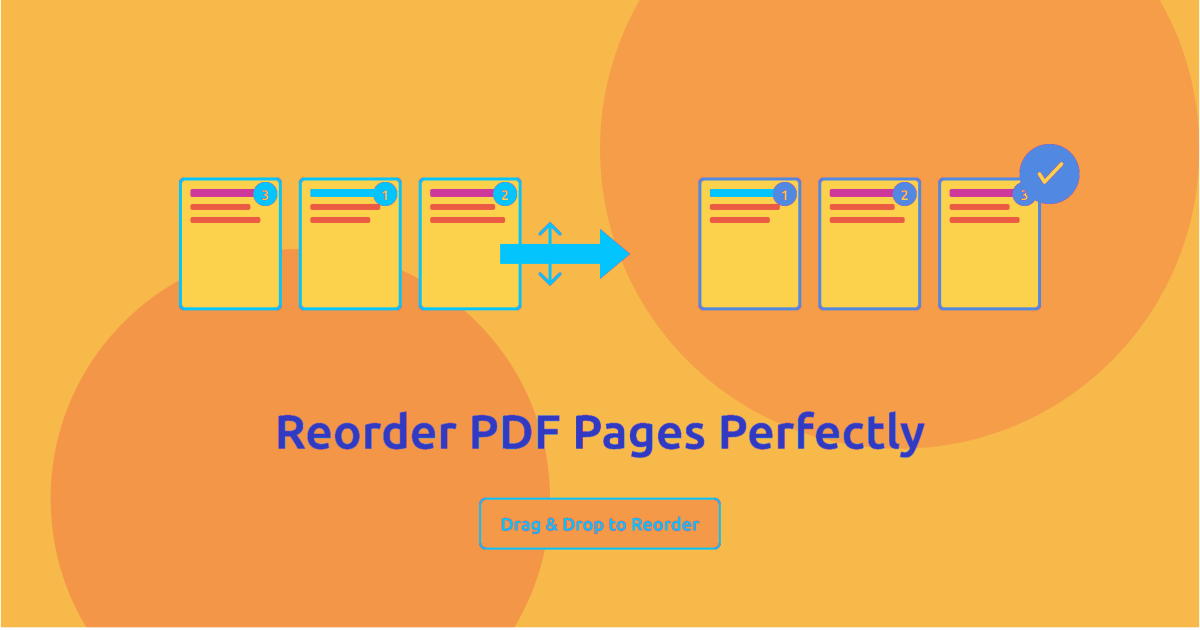
New position badge: Shows new page number (top-right corner)
Original page label: Shows original page number (bottom center)
Drag handle: Appears on hover to indicate draggable
Live preview: Footer shows complete new page sequence
Opacity change: Dragged page becomes semi-transparent
Grid layout: 4-6 columns depending on screen size
The live preview at the bottom shows your complete new page order (e.g., "3, 1, 2, 4, 5...") so you can verify before applying changes.
Step 4: Download Reordered PDF
Click "Apply Reorder" and download your reorganized document:
Instant processing
Original quality maintained
New page sequence applied
Ready to use
Advanced Reordering Techniques
Complex Page Reorganization
Handle sophisticated reordering needs:
Multi-Page Moves
Select multiple pages at once
Move entire sections together
Maintain relative page order
Efficient bulk repositioning
Section Restructuring
Identify logical sections
Move complete chapters
Resequence entire segments
Preserve internal structure
Interleaving Pages
Alternate pages from different sources
Create comparison documents
Build integrated materials
Custom page patterns
Page Sequencing Patterns
Common reordering scenarios and solutions:
Ascending to Descending
Original: 1, 2, 3, 4, 5
New: 5, 4, 3, 2, 1
Use: Reverse order function
Common for: Certain scanning errors
Move Conclusion First
Original: Intro, Body, Conclusion
New: Conclusion, Intro, Body
Use: Drag conclusion pages to start
Common for: Executive summaries
Chapter Resequencing
Original: Ch1, Ch2, Ch3, Ch4
New: Ch3, Ch1, Ch4, Ch2
Use: Drag entire chapter sections
Common for: Custom reports
Fix Scanning Errors
Original: 1, 3, 2, 5, 4, 6
New: 1, 2, 3, 4, 5, 6
Use: Swap individual pages
Common for: Auto-feeder mistakes
For documents with many misplaced pages, create a written plan of your desired order before beginning to reorder.
Batch Reordering Strategies
Efficient techniques for large documents:
Zone Approach
Divide document into sections
Reorder within each section first
Then reorder sections themselves
Verify final sequence
Reference Method
Create ordered list of desired sequence
Work through list systematically
Check off each repositioning
Final verification pass
Iterative Refinement
Make major structural changes first
Then handle smaller adjustments
Fine-tune final positions
Verify logical flow
Reordering Best Practices by Use Case
Scanned Documents
For fixing scanning errors:
Review entire document first
Identify all out-of-sequence pages
Note if pages are upside down (rotate separately)
Check for duplicate or missing pages
Reorder systematically from start to end
Reports and Presentations
For restructuring business documents:
Place executive summary first
Group related sections together
Move appendices to end
Position supporting data logically
Ensure narrative flow
Legal Documents
For contract and filing organization:
Maintain chronological order where required
Group exhibits with relevant sections
Position signature pages appropriately
Preserve original page numbering references
Document any reordering done
Academic Papers
For research and publication assembly:
Standard order: Title, Abstract, Intro, Methods, Results, Discussion, References
Position figures and tables near references
Move appendices to end
Group supplementary materials
Follow journal formatting requirements
Multi-Source Assembly
For combining materials from different PDFs:
Split source documents first
Extract needed pages
Plan final page sequence
Merge and reorder together
Verify cohesive flow
Common Reordering Scenarios
Scenario 1: Fix Duplex Scanning Error
Problem: Double-sided scanning resulted in odd pages followed by even pages Solution:
Original order: 1, 3, 5, 7, 2, 4, 6, 8
Interleave pages: 1, 2, 3, 4, 5, 6, 7, 8
Use systematic drag-and-drop
Verify correct sequence
Scenario 2: Move Executive Summary to Front
Problem: 50-page report has summary on pages 48-50 Solution:
Select pages 48-50
Move to position 1-3
Original pages 1-47 shift to 4-50
Professional document structure
Scenario 3: Reorganize Chapters
Problem: Book chapters need resequencing Solution:
Identify chapter page ranges
Move entire chapters as blocks
Maintain internal chapter order
Create new logical flow
Scenario 4: Fix Accidentally Reversed Pages
Problem: Pages 10-20 were scanned in reverse order Solution:
Select pages 10-20
Use reverse order function on selection
Rest of document unchanged
Corrected sequence
Scenario 5: Create Custom Client Version
Problem: Need to reorder standard report for specific client emphasis Solution:
Identify client's priority sections
Move those sections forward
Retain all content
Customized presentation
Visual Organization Tips
Make reordering easier with these techniques:
Use Page Thumbnails Effectively
Zoom Level
Adjust thumbnail size for visibility
Larger for detailed review
Smaller for document overview
Find your optimal working size
Visual Markers
Identify distinctive page elements
Use headers and footers as guides
Recognize unique content
Speed up page identification
Grid vs List View
Grid: Better overview of many pages
List: Easier for precise ordering
Choose based on document size
Switch views as needed
Track Your Changes
Keep Notes
Document major reorderings
Note original page positions
Record reasoning for changes
Maintain change log for important documents
Undo Capability
Test reordering before finalizing
Keep original PDF until verified
Create versions if uncertain
Easy rollback if needed
Troubleshooting Reordering Issues
Difficult to Identify Pages
If pages look similar:
Zoom in on thumbnails
Look for page numbers on pages
Check headers and footers
Read first few words of each page
Solution: Increase thumbnail size and look for unique text or images on each page.
Lose Track of Desired Order
If you forget your reordering plan:
Start over with clear plan
Write down desired sequence
Work systematically
Check off completed moves
Solution: Create written list of desired order before beginning.
Accidentally Move Wrong Pages
If you make a mistake:
Use undo function immediately
Reset to original order
Start reordering again
Work more slowly and carefully
Solution: Verify each move before proceeding to the next.
Large Documents Are Slow
If interface lags with many pages:
Work in sections (split then merge)
Use page number entry method
Reduce thumbnail quality temporarily
Process on desktop instead of mobile
Solution: Split large PDFs into manageable sections, reorder each, then merge back together.
Final Order Still Incorrect
If result isn't as intended:
Compare with your written plan
Identify remaining issues
Upload and reorder again
Double-check before finalizing
Solution: Always preview final result before saving and distributing.
Combining with Other Operations
Maximize efficiency by combining reordering with other tools:
Reorder + Rotate
Reorder pages into correct sequence
Rotate individual pages as needed
Fix both order and orientation
Complete document correction
Reorder + Split
Reorder full document
Split into logical sections
Distribute sections separately
Organized multi-file output
Reorder + Merge
Extract pages from multiple PDFs
Merge into single document
Reorder combined pages
Create custom compilation
Reorder + Delete
Reorder to group unwanted pages
Delete unnecessary sections
Streamline document
Efficient content curation
Preventing Reordering Needs
Avoid page order issues from the start:
Scanning Best Practices
Consistent Feeding
Feed pages in correct order
Check page orientation before scanning
Use document feeder properly
Preview before saving
Scanner Settings
Enable page numbering
Use sequential file naming
Test with small batch first
Verify before bulk scanning
Quality Control
Review scanned PDF immediately
Check page sequence
Verify all pages present
Rescan if needed rather than reorder
PDF Creation Best Practices
From Word/Office
Organize document before export
Use section breaks properly
Verify print preview
Check page order in outline view
From Multiple Sources
Plan page sequence in advance
Name files sequentially
Merge in correct order initially
Reduce need for reordering
Collaborative Documents
Establish page organization standards
Use clear section headings
Number pages consistently
Communicate structure to team
Mobile vs Desktop Reordering
Desktop Reordering
Advantages:
Larger screen shows more pages
Easier drag and drop
Better for complex reordering
Faster processing
Best for:
Large documents
Complex reorganization
Professional work
Detailed review
Mobile Reordering
Advantages:
Reorder on-the-go
Touch-based dragging
Quick fixes anywhere
PDFHaul mobile-optimized
Best for:
Small documents
Simple page swaps
Emergency fixes
Immediate needs
PDFHaul's responsive interface works seamlessly on all devices, adapting the reordering interface to your screen size for optimal usability.
When Reordering Isn't the Solution
Some issues require different approaches:
Page Numbering Issues: Need PDF editor to change printed page numbers Missing Pages: Require re-scanning or obtaining missing content Duplicate Pages: Use remove duplicates tool instead Content Organization: May need document restructuring, not just reordering Complex Layouts: Might need professional PDF editing software
Conclusion
PDF page reordering is a fundamental document management skill that ensures professional organization and logical content flow. With the right techniques and tools, you can transform disorganized PDFs into perfectly sequenced documents quickly and efficiently.
Key Takeaways:
Plan your desired page order before beginning
Use drag-and-drop for visual simplicity
Work systematically through complex reorderings
Preview final result before saving
Combine with other operations for comprehensive document management
Ready to reorder your PDF pages? Try PDFHaul's reorder tool now - free, intuitive, and precise.
Frequently Asked Questions
Q: Does reordering PDFs affect quality?
A: No, reordering is completely lossless. Pages are simply repositioned without any quality degradation or content modification.
Q: Can I undo reordering if I make a mistake?
A: You can close the reorder modal without applying changes, or keep your original PDF as backup before downloading the reordered version.
Q: How many pages can I reorder at once?
A: PDFHaul supports reordering documents up to 100MB with unlimited page count.
Q: Will reordering affect page numbers printed on pages?
A: No, printed page numbers remain unchanged. Only the sequence of pages in the PDF file changes.
Q: Can I reorder password-protected PDFs?
A: You must unlock password-protected PDFs before reordering. After reordering, you can reapply password protection.
Q: Will bookmarks and links still work after reordering?
A: Internal bookmarks and links are automatically updated to point to the new page positions.
Written by PDFHaul Team
Expert team specializing in PDF processing and document management. We share practical tips, tutorials, and best practices to help you work smarter with PDFs.
View all articles